How Golf Handicap Is Calculated — The Complete WHS Guide
Your Handicap Index is a single number that represents your demonstrated playing ability — specifically, your potential on a good day, not your average. It lets golfers of any skill level compete fairly against each other, whether you shoot 75 or 105.
The Handicap Index travels with you from course to course. It's calculated under the World Handicap System (WHS), the global standard used in the US, UK, Australia, and most countries worldwide. Every legitimate handicap app, including ParPal, uses this same system.
Think of your Handicap Index as a portable, self-updating measure of how good you are. Post rounds, and it adjusts automatically.
How is a golf score differential calculated?
A score differential measures how well you played one round relative to the difficulty of the course you played that day. Every round produces one differential, and your Handicap Index is built from those differentials over time.
The formula:
Score Differential = (Adjusted Gross Score − Course Rating) × 113 ÷ Slope Rating
Here's what each piece means:
- Adjusted Gross Score (AGS): Your total strokes for the round, with a maximum score applied on each hole (called Net Double Bogey). There's a cap per hole that keeps one bad hole from wrecking your whole round.
- Course Rating: The score a scratch golfer (0 handicap) is expected to shoot on that course, from those tees.
- Slope Rating: A number between 55 and 155 that measures how much harder the course plays for a bogey golfer compared to a scratch golfer. The average Slope Rating is 113.
- 113: The neutral Slope Rating used as a baseline so every differential is comparable across courses.
Worked example: You shoot an 88 (Adjusted Gross Score) on a course with a Course Rating of 71.2 and a Slope Rating of 128.
(88 − 71.2) × 113 ÷ 128 = 16.8 × 113 ÷ 128 = 14.8
Your score differential for that round is 14.8. ParPal calculates this automatically the moment you log your round — you never have to do this math yourself.
For a deeper look at differentials — including negative differentials, the Net Double Bogey cap, and weather (PCC) adjustments — see What Is a Score Differential in Golf?.
What do Course Rating and Slope Rating mean?
Course Rating and Slope Rating are two numbers printed on every scorecard. Together they describe how hard a course is — and they work for different types of golfers.
Course Rating tells you what a scratch golfer should score. A par-72 course might have a rating of 71.4 or 73.8 depending on its length and difficulty. The lower the Course Rating relative to par, the easier it plays for elite golfers.
Slope Rating tells you how much harder the course is for an average bogey golfer compared to that scratch golfer. A Slope of 155 is extremely difficult for higher-handicap players. A Slope of 100 is a more forgiving layout. The average is 113, which is why 113 appears in the differential formula — it normalizes every round to that baseline.
Together, these two numbers ensure that your differential from a brutally hard course is comparable to your differential from an easy course. Without them, a round on a tough layout would look much worse than the same quality of play on a simple one.
For a deeper breakdown of these two numbers and how they differ, see Course Rating vs Slope Rating — What's the Difference?.
30 Seconds to Better Golf
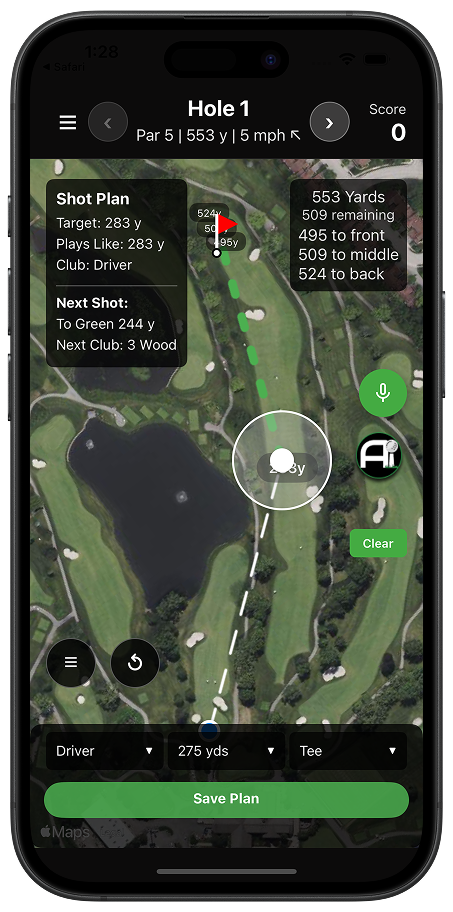
Download ParPal, open it on the tee, and get GPS yardages, wind-adjusted distances, and the smart club call—before your first swing.
Get ParPal FreeFree · iPhone & Android · Set up in about 30 seconds
How is a Handicap Index calculated from your rounds?
Once you have score differentials from your rounds, your Handicap Index is calculated using the best 8 of your most recent 20 rounds.
Here's the process:
- Look at your 20 most recent score differentials.
- Identify the 8 lowest (best) ones.
- Average those 8 differentials.
- That average, rounded to the nearest tenth, is your Handicap Index.
Why the best 8 of 20? Because the system is designed to reflect your potential — how well you can play on a good day — not just your average. It rewards consistency and improvement without letting a few bad rounds drag your number up unfairly. (Curious where your number ranks among other golfers? See What Is a Good Handicap Index?.)
What if you have fewer than 20 rounds? The system uses a stepped table so you can get an index as soon as you have 3 rounds posted. The number of differentials used scales up as you add more rounds.
What is the soft cap and hard cap?
The WHS includes two safeguards that limit how quickly your Handicap Index can rise in a short period. They exist to prevent handicap manipulation and to keep your index accurate.
Soft cap: When your calculated Handicap Index would rise more than 3.0 strokes above your Low Handicap Index (the lowest index you've held in the last 12 months), further increases are reduced by 50%.
Hard cap: Your Handicap Index can never rise more than 5.0 strokes above your Low Handicap Index in any rolling 12-month period.
So if your lowest index in the past year was 12.0, your index can rise freely up to 15.0, slows down between 15.0 and 17.0, and cannot exceed 17.0 — no matter how many bad rounds you have. These caps mean a few rough rounds at the end of a season won't suddenly inflate your handicap to an unrealistic level.
How do 9-hole rounds count toward your Handicap Index?
Under WHS, 9-hole rounds count — they just work slightly differently than 18-hole rounds.
A 9-hole round produces a 9-hole score differential. The system then pairs that 9-hole differential with either another 9-hole differential or an expected-score value to create a combined 18-hole differential, which is then added to your scoring record just like a full round.
This means you can absolutely build and maintain a Handicap Index playing only 9-hole rounds. It takes a bit more time since each round counts as half, but the math is fully WHS-compliant. ParPal handles 9-hole pairing automatically — you log the 9-hole score and the app does the rest.
For the full 9-hole breakdown — the 2024 rule change and how to find your 9-hole Course Handicap — see 9-Hole Golf Handicap: How 9-Hole Rounds Count.
How long does it take to get a Handicap Index?
You can establish a Handicap Index with as few as 3 rounds (54 holes minimum). The index reaches full accuracy — meaning the complete best-8-of-20 calculation — once you have 20 rounds on record.
Most recreational golfers playing once or twice a week can have a full 20-round index within a season. But the number you get after 3 rounds is legitimate and usable right away. For the full stepped table showing how the calculation evolves, see How Many Rounds Do You Need for a Golf Handicap?.
How is a Course Handicap different from a Handicap Index?
Your Handicap Index is your portable, universal number. Your Course Handicap is what you actually use on the day — it converts your index to strokes for the specific tees you're playing.
The formula:
Course Handicap = Handicap Index × (Slope Rating ÷ 113) + (Course Rating − Par)
If your Handicap Index is 14.8 and you're playing a course with Slope 128, Course Rating 71.2, and Par 72:
14.8 × (128 ÷ 113) + (71.2 − 72) = 14.8 × 1.133 − 0.8 = 16.0 − 0.8 = 15.2 → rounds to 15
Your Course Handicap is 15 for that round — meaning you get 15 strokes to add to your net score. ParPal shows you your Course Handicap automatically when you start a round. (Want to run your own numbers? Try the WHS Handicap Calculator.)
Does ParPal calculate my Handicap Index automatically?
Yes. ParPal records every round you log and calculates your WHS-compliant Handicap Index in real time. You see your updated index after each round — no math, no spreadsheets, no third-party handicap service required.
The app handles score differentials, 9-hole pairing, the stepped table for new golfers, and the soft and hard caps — all in the background. Your job is to play and post the score.
Frequently Asked Questions
What is the minimum number of rounds to get a golf handicap?
You need a minimum of 3 rounds (54 holes) to establish a Handicap Index under the World Handicap System. Your index reaches full accuracy after 20 rounds, when the best-8-of-20 calculation uses a complete set of data.
How often does my Handicap Index update?
Under WHS, your Handicap Index updates every time you post a new score. There is no waiting period — post a round today and your index reflects it immediately (or daily, depending on your platform's posting schedule).
Is the World Handicap System the same in every country?
Yes. WHS was introduced in 2020 to unify six regional handicap systems into one global standard. Whether you play in the US, UK, Ireland, Australia, or elsewhere, the same calculation applies.
Can my Handicap Index go up?
Yes. Your index reflects your recent scoring record. If you have a run of rounds that are significantly worse than your best differentials, your index will rise. The soft cap and hard cap limit how fast it can increase.
What's the difference between a Handicap Index and a handicap?
"Handicap Index" is the official WHS term for your portable playing-ability number. "Handicap" is a casual shorthand for the same thing. They refer to the same concept — but in formal contexts (scorecards, competition entry) the term is Handicap Index.
Let ParPal Do the Math
ParPal calculates your WHS-compliant Handicap Index automatically — just log your rounds and let the app handle the rest. No formulas, no spreadsheets.
Get ParPal FreeFree · iPhone & Android · Set up in about 30 seconds