Course Rating vs Slope Rating — What's the Difference?
Course Rating measures how difficult a golf course is for a scratch golfer — someone with a 0.0 Handicap Index. Slope Rating measures how much harder that same course plays for an average bogey golfer compared to that scratch player. Together, these two numbers let the World Handicap System calculate a fair Course Handicap for any golfer, on any course, at any skill level.
They answer two different questions: Course Rating tells you "how hard is this course in absolute terms?" Slope Rating tells you "how much harder does this course get as you move from an elite player to an average one?"
What is Course Rating?
Course Rating is the score a scratch golfer is expected to shoot on a given course, from a specific set of tees, on a normal day. It's expressed in strokes — for example, a Course Rating of 72.4 means a scratch golfer should expect to shoot right around 72.4.
A few things to know about Course Rating:
- It's tee-specific — the same course has a different Course Rating for each set of tees (forward tees vs back tees, for example).
- It's not the same as Par — a course rated 72.4 with a par of 72 is playing slightly harder than its par for a scratch golfer; a course rated 70.1 with a par of 72 is playing slightly easier.
- It represents absolute baseline difficulty — independent of how that difficulty is distributed across skill levels.
What is Slope Rating?
Slope Rating measures the relative difficulty gap between a scratch golfer and a bogey golfer (roughly a 20-handicap player for men, 24 for women) on that same course. It's expressed on a scale from 55 to 155, with 113 representing average difficulty.
A few things to know about Slope Rating:
- A Slope Rating higher than 113 means the course gets disproportionately harder for higher-handicap players compared to scratch players.
- A Slope Rating lower than 113 means the gap between scratch and bogey golfers is smaller than average — the course is more forgiving for higher-handicap players relative to its difficulty for scratch players.
- Like Course Rating, Slope Rating is specific to each set of tees.
The key distinction: a course can have a relatively low Course Rating (manageable for elite players) but a very high Slope Rating — meaning it's deceptively brutal for higher-handicap golfers, even though it doesn't look that hard "on paper" for a scratch player.
How do Course Rating and Slope Rating work together?
These two numbers are paired specifically to keep handicaps fair across different courses and different skill levels. Here's why both are necessary:
If you only had Course Rating, you'd know how hard a course is for elite players — but you'd have no idea how that difficulty translates for an average golfer. A course could be moderately hard for a scratch player (Course Rating 71) but absolutely punishing for a 20-handicap golfer due to narrow fairways, deep rough, and forced carries (Slope Rating 145).
If you only had Slope Rating, you'd know the relative difficulty gap, but not the absolute baseline — you wouldn't know if a course is hard in general or just relatively harder for higher handicaps.
Together, they let the Course Handicap formula adjust your Handicap Index correctly for the exact course and tees you're playing:
Course Handicap = Handicap Index × (Slope Rating ÷ 113) + (Course Rating − Par)
For the full Course Handicap walkthrough with worked examples, see How Golf Handicap Is Calculated — The Complete WHS Guide. You can also plug your own numbers into the WHS Handicap Calculator.
30 Seconds to Better Golf
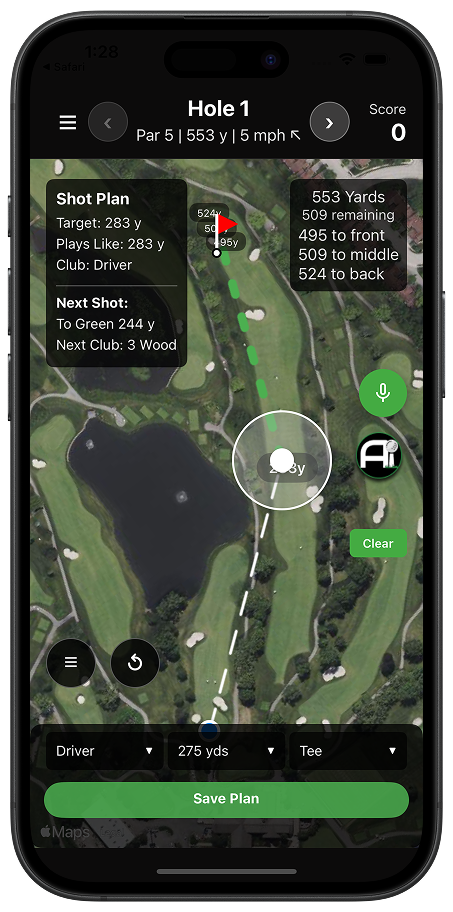
Download ParPal, open it on the tee, and get GPS yardages, wind-adjusted distances, and the smart club call—before your first swing.
Get ParPal FreeFree · iPhone & Android · Set up in about 30 seconds
Is a 140 Slope Rating hard?
Yes — a Slope Rating of 140 is considered difficult. Since 113 represents average difficulty and the scale tops out at 155, a 140 puts a course well into the harder end of the range, particularly punishing for higher-handicap golfers relative to scratch players. Courses with narrow landing areas, significant length, and tough recovery shots tend to carry slope ratings in this range.
Is a 72 Course Rating hard?
A Course Rating of 72 on a par-72 course means a scratch golfer is expected to shoot right around par — that's a moderately challenging course, but not extreme. Context matters: a Course Rating of 72 on a par-70 course would represent a much harder layout, since it means a scratch golfer is expected to shoot 2 over par.
Where do you find Course Rating and Slope Rating?
Both numbers are printed on the scorecard, usually next to the tee box you're playing. They're also available in official course rating databases maintained by golf associations, and in most golf apps that have the course pre-loaded.
ParPal pulls Course Rating and Slope Rating automatically for every course in its database the moment you select your tees — you don't need to check the scorecard or look anything up manually.
Frequently Asked Questions
How is Course Rating calculated?
Course Rating is determined by a trained course rating team that evaluates the course's playing length and obstacles for a scratch golfer, following official methodology set by the World Handicap System governing bodies.
How is Slope Rating calculated?
Slope Rating is calculated from the difference between the Course Rating and the Bogey Rating (the expected score for a bogey golfer) — the larger that gap, the higher the Slope Rating.
What is the average Slope Rating?
113 is the average, or "standard difficulty," Slope Rating — it's also the constant used in the score differential formula.
Can two courses have the same Course Rating but different Slope Ratings?
Yes, and it happens often. Two courses can be equally hard for a scratch golfer (same Course Rating) while one is significantly harder for higher-handicap golfers than the other (different Slope Ratings).
Do Course Rating and Slope Rating change for different tees on the same course?
Yes. Every set of tees at a course has its own Course Rating and Slope Rating, since playing length and the angles of approach change significantly between tee boxes.
Stop Squinting at the Scorecard
ParPal pulls the correct Course Rating and Slope Rating automatically for every course and tee you play — and turns them into your Course Handicap on the spot.
Get ParPal FreeFree · iPhone & Android · Set up in about 30 seconds