Golf Club Distance Chart: How Far Should You Hit Each Club?
A 15-handicap man hits his 7-iron about 154 yards and his driver about 236, counting roll. That's from Shot Scope, which tracks shots from real rounds. The full chart by handicap is below.
The more useful number is your own, so after the chart I'll show you how to build yours.
One thing to be aware of is the loft of your clubs. For example, the TaylorMade P790s that I play are strong, so my current 7-iron is the loft of my older 6-iron. But it's critical to know how far you hit each club in different conditions and for how you feel that day. Cold, damp mornings vs. hot, dry afternoons will deliver different results that you need to know. So spend the time to get your distances and plug them into ParPal so it can keep track for you.
Average golf club distances by handicap (men)
These are Shot Scope's "performance average" numbers. They take out outliers, like topped shots. They're total distance, carry plus roll. (Golf Monthly, Shot Scope data)
| Club | Scratch | 5 hcp | 10 hcp | 15 hcp | 20 hcp | 25 hcp |
|---|---|---|---|---|---|---|
| Driver | 285 | 261 | 259 | 236 | 225 | 204 |
| 3-wood | 261 | 234 | 227 | 215 | 195 | 178 |
| Hybrid | 237 | 216 | 214 | 197 | 180 | 162 |
| 4-iron | 223 | 201 | 199 | 186 | 169 | 151 |
| 5-iron | 200 | 183 | 187 | 169 | 162 | 143 |
| 6-iron | 185 | 172 | 171 | 162 | 151 | 137 |
| 7-iron | 178 | 164 | 161 | 154 | 146 | 132 |
| 8-iron | 166 | 153 | 150 | 146 | 138 | 122 |
| 9-iron | 155 | 139 | 140 | 136 | 129 | 108 |
| PW | 141 | 126 | 127 | 121 | 108 | 90 |
| Gap wedge | 126 | 109 | 110 | 104 | 94 | 79 |
| Sand wedge | 105 | 86 | 98 | 84 | 85 | 80 |
| Lob wedge | 86 | 71 | 79 | 75 | 78 | 49 |
All distances in yards.
A few things jump out:
- Mid-handicaps are closer than you'd think. A 10 and a 15 are 7 yards apart with a 7-iron (161 vs 154). Distance alone doesn't explain the gap in their scores.
- Wedges get messy. Higher handicaps hit sand and lob wedge about as far as better players, and sometimes farther. My guess is that's partial swings and inconsistent contact showing up in the data.
- Not sure where you fit? See what counts as a good handicap index.
What about women golfers?
The USGA measured 627 recreational golfers on TrackMan launch monitors between 2021 and 2023. These are their "ability" distances — the median shot, not the average (USGA study, 2023 update):
| Club | Women | Men |
|---|---|---|
| Driver | 144 | 226 |
| 7-iron | 98 | 149 |
| Pitching wedge | 80 | 117 |
Only three clubs, but it's a measured sample of everyday golfers, not tour players or long hitters.
Carry vs. total distance
This trips people up. Two kinds of numbers float around:
- Total distance is where the ball stops. Shot-tracking data from rounds (like the Shot Scope chart above) includes roll.
- Carry is how far it flies. Launch monitors like TrackMan measure it.
For picking a club, carry matters more. If there's a bunker 150 out in front of the green, you need to fly it 150, not roll it there. A TrackMan blog post from 2017 put the average male amateur's driver carry at 204 yards with 93.4 mph of club speed (TrackMan). That's a long way short of most total-distance averages.
Most golfers think they hit it farther than they do
The main point of that USGA study was to compare what golfers said they hit each club with what TrackMan measured. On average:
- Driver: golfers overestimated their typical distance by 7%, and even overestimated their best drives by 4%.
- 7-iron: overestimated by 4%.
- Pitching wedge: about right.
The USGA's take is that golfers quote their best drives, not their normal ones. On a 220-yard drive, 7% is about 15 yards. That's a club or more on your second shot.
How to build your own club distance chart
The averages tell you what's normal. Your chart tells you what to hit. Here's how I'd do it.
- Use a launch monitor if you can get on one. A lot of ranges and golf shops have them. You want carry numbers.
- Hit 7 to 10 balls with each club. Swing your normal swing, not your hardest.
- Write down the middle number, not the best one. That's basically what the USGA called "ability": the median of your shots. Your best shot is your ceiling, not your plan.
- No launch monitor? Use the course. Track where your full shots land over a few rounds with a GPS app and use the typical number.
- Look for gaps and overlaps. If two clubs go the same distance, one of them may not need to be in the bag. If there's a big gap, that's where a hybrid or extra wedge earns its spot.
- Redo it each season. Distances change with new clubs, cold weather, and age.
Put Your Distances in ParPal
Enter your club distances once. Free GPS and scorecard on iOS, Android, and Apple Watch.
Get ParPal FreeFree · iPhone & Android · Set up in about 30 seconds
Where ParPal fits
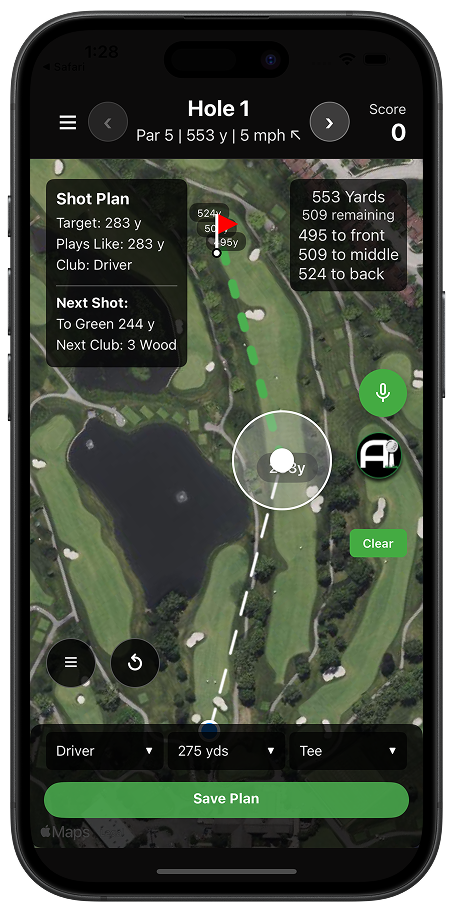
When you set up ParPal, you enter your club distances once.
On Pro ($69.99/year), the AI caddy uses those distances, plus wind, lie, and your own history, to suggest a club. A number isn't a decision. The point is to turn "152 to the pin" into "smooth 7, aim at the middle."
Basic is free. It's a fast, good-looking GPS and scorecard. It doesn't give club recommendations.
Download ParPal. iOS, Android, and Apple Watch. No sensors or club tags.
FAQ
How far should I hit my 7-iron?
It depends on your handicap. Shot Scope's averages for men run from 132 yards (25 handicap) to 178 (scratch), counting roll. The USGA's measured typical (median) distance for men was 149 yards and for women 98.
How far does the average golfer hit a driver?
The USGA's measured typical (median) distance was 226 yards for men and 144 for women. A 2017 TrackMan study put average male amateur carry at 204.
Should my chart use carry or total distance?
Carry. Total distance changes with firm or soft ground. Carry is what gets you over trouble.
How often should I update my club distances?
Any time you change clubs, and at least once a season.
Know Your Numbers
Free to download on iOS, Android, and Apple Watch. Pro adds AI caddy club advice for $69.99/year.
Get ParPal FreeFree · iPhone & Android · Set up in about 30 seconds